
This is a great question and one I get asked frequently. There isn't a set formula that can be applied to all situations. There is a big difference between transitioning to a Newton shoe, a pair of FiveFingers, or completely barefoot. Newton shoes have more protection than your bare feet and therefore will require less time to safely adapt than a pure minimalist shoe. The most important question to ask is whether you are prepared to set your goal as running barefoot/minimalist rather than a set amount of mileage per week.
Paradoxically a young runner would need to transition into traditional running shoes in my opinion. Imagine the kid playing soccer in flat Sambas or the Kenyan runner being given a first pair of elevated heel running shoes. Do we suggest "take it slow in these or you may get hurt". We should though, and maybe this is part of why so many high school runners get hurt now as we read stories of runners of years gone by and wonder how they ran without injury. So, the first message is DO NOT LET YOUNG RUNNERS TRANSITION INTO TRADITIONAL RUNNING SHOES AND CHANGE THEIR NATURAL RUNNING MECHANICS.
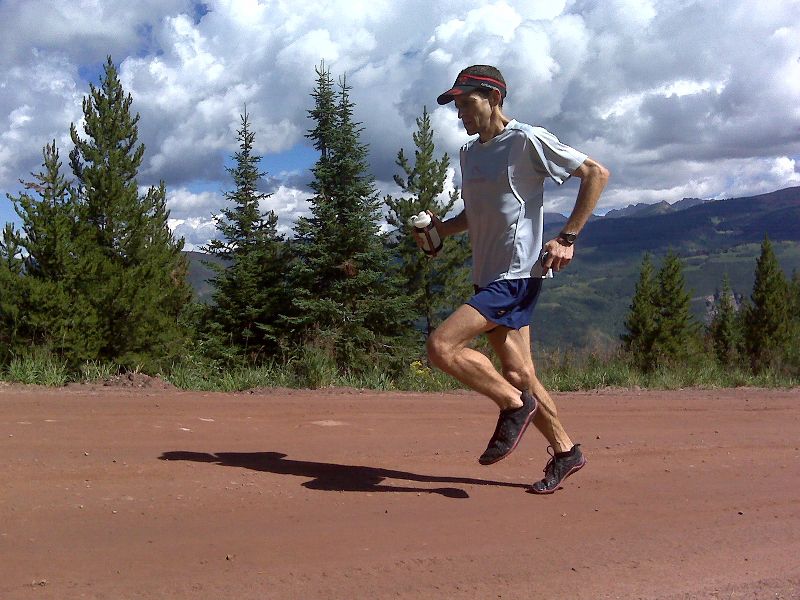
In our store we have a protocol to help folks. If a runner is strong in a single leg stance, has an anatomically correct foot, nice flexible heel cords, and a good gait, they are ready to roll pretty quick and do not need much transition. They feel great immediately.
The opposite is true for someone who fails all these parameters. They need lots of supplemental work and need to get in a flat shoe all day. Walking barefoot and in thin and flat street shoes is very helpful for the running transition.
A transition over a week or two is possible if one already has strong feet, is committed to form training and understanding structural issues, and is able to ease in with slow running and body awareness. The only way to really learn good form is to chuck the traditional shoes and do some running and drills in bare feet.
There are lots of common sense gradual progressions but no clear science. Here are a few suggestions:
- Add a mile every day or two until you are doing all running in minimalist shoes
- Add 5 minutes every day or two in minimalist shoes
- Add 10% a week in minimalist shoes
Dial in really good form early on and in 3 weeks you will have neuromuscular changes that are hard wired. Work on getting your cadence closer to 180 steps per minute. As with fixing a swim stroke or golf swing... fix it immediately. Listen to your body, work on strengthening the core and practicing mobility exercises to support barefoot technique. Progress gradually. Pick up materials on Chi Running, Pose Running, or Evolution Running for good self instruction - all of these techniques offer great tips. Remember, you are trying to rewire a mechanical movement to a new “natural”. It takes time and commitment.
If you have a specific pain you need to listen to your body, ask "why?", and figure it out.
Some good reference material:
- 12 Steps to Healthier Running - A nice reference from our store on how to get ready to run in more minimal shoes
- Transitioning to Minimalism - A Running Times Article on how to make the transition
- Clinics - If you are in the area, come to one of our clinics for a hands on assessment to tailor a program that is safe for you
Here’s to healthier running, pain free!