
Barefoot Walking Gait
You see a lot of talk in minimalist circles all over the web about running form. It is widely acknowledged that in order to reduce injury and maximize health we not only need to minimize footwear, but that we need to become students of form. If we don't, we are still at risk of getting injured.
There is a lot of content on the topic of proper running form, however nobody seems to be spending much time talking about walking. Often when I see walking mentioned, it is just a footnote in the din of running chatter.
While I do enjoy running, it isn't the whole picture of my life. On a daily basis, I spend much more of my time walking, hiking, and backpacking. I believe that gait is really important for those activities as well, and that we need to spend more time thinking about the bigger picture of natural human locomotion.
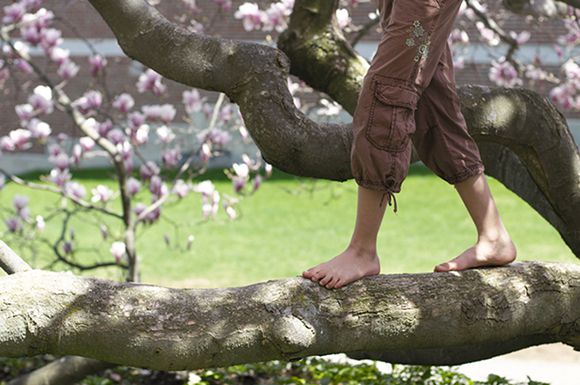
When I wrote my series The Case for Minimalist Footwear, I got a lot of flac from some experts on walking. In my articles I stated that I believed that a forefoot landing was the "ideal" walking form while the opposition stated that it was unnatural, inefficient, and that it would lead to injury. These days, I am a little more balanced in my opinion on the topic. I now believe that we are both right, and that the gait we use really depends on a large number of factors.
Motivators
Evolutionary psychologists state that humans (probably most animals) have three primary motivators that drive decision making (at the subconscious level):
- They seek pleasure
- They avoid pain
- They conserve energy
That is why high calorie food tastes pleasurable, sex feels good, poking ourselves with sharp sticks hurts, and we love dishwashers. These three simple motivators help us to successfully navigate our world as a species. They are also primarily responsible for our some of our biggest problems: we are (for the most part) lazy, sick, and fat. What we can infer from this is that, when held in perfect balance in the natural world those motivators work to help us succeed. However in an unnatural world where the balance is skewed, they work against us.
What does this have to do with walking?
In most of my reading I have found that the commonly accepted optimal gait for walking is to land on the heel and roll to the forefoot. That is considered the most energy efficient form of walking, and thus that is why we have evolved to use it.
I believe that is only part of the picture as I have observed at least two additional gait patterns: a midfoot landing and a forefoot landing.
When asked, experts argue that those gaits are less energy efficient and unnatural for walking. If efficiency (i.e. energy conservation) were all that mattered then I might agree. I believe however that those gaits are equally natural and that they have very specific purposes: pain avoidance and stability.
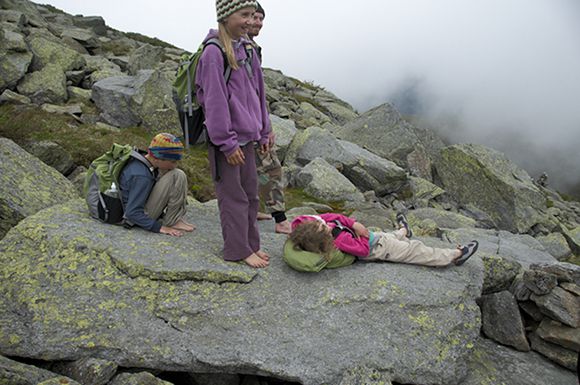
If you take off your shoes and walk on rough, uneven terrain, your body will have increased stability and less pain if you adopt a forefoot or midfoot landing. Try it. Go for a walk over a rocky trail and see what type of gait your body feels comfortable using. If you are like most, you will probably adopt a "tender-foot" strike where you take short steps with a forefoot landing. Your body will be in full-on stability and pain avoidance mode.
I believe that we will use the most efficient gait to some threshold where pain avoidance takes over and we switch to a less painful one. So, when walking on sand, energy efficiency trumps pain avoidance. When walking on rocks, pain avoidance and stability will trump energy efficiency. If you are aware of the difference, you can turn one or the other on/off at will depending on the activity.
In the natural world we had all kinds of different terrain to walk on. Over the course of a day, I would assume that we walked sometimes with a forefoot strike and sometimes with a heel strike. As a result all of the muscles of our feet were well developed for all kinds of gaits. Fast forward to the modern world. Everything is flat and safe and we wear shoes. As a result the gait we adopt for everything is a heel strike and our feet have become under-developed for anything else. We are not used to walking for stability and pain avoidance because we never have to.
Under developed foot muscles and improper movement patterns are large factors in how susceptible we are to injury. If we train our bodies 95% of the time on flat, safe surfaces we are going to have only one gait burned into our brain: a heel-first landing. When we hit the trail hiking or backpacking, we will continue with our heel strike as if we are walking down a sidewalk because that is all we know. When we find ourselves in a sticky/unstable situation we will be ill equipped to deal with it.
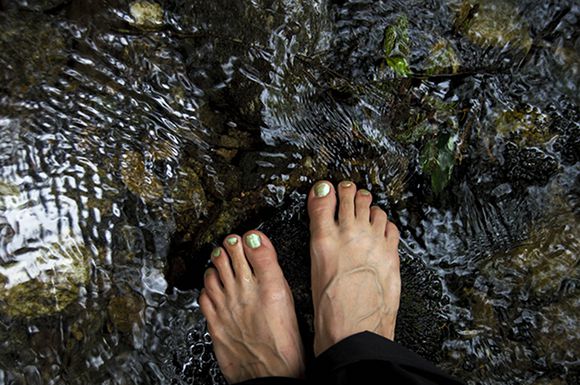
Not so long ago I interviewed a barefoot thru-hiker. She wasn't doing it because she was some sort of barefoot purist attempting to prove a point. She ditched the footwear because she was in pain and needed a solution. She didn't spend days on end researching optimal gait patterns and doing drills to re-train her muscle memory. She just took off her shoes and hiked. When I asked her what sort of foot strike she found she used most, this is what she told me:
"Generally come down on the ball of my foot, just lightly setting the heel down briefly. On the flat my feet come down more flat on the side of the foot. Either way I roll off my big toe at each step."
I wonder what the biomechanic experts have to say about that?
What are your thoughts on walking gait?


Comments
I think that part of the
I think that part of the reason barefoot walking gait is rarely discussed is that there is much less impact while walking than in running. There is generally less risk of injury while walking. I do think that it is still an important topic to consider. Thanks for the informative article!
Terral Fox
There is less impact, but
There is less impact, but there are sure a lot of hikers/backpackers that suffer all kinds of knee and ankle injuries.
Damien Tougas
http://www.adventureinprogress.com
http://www.toesalad.com
Walking Gait
I can't claim to have thought much about walking gait, but on a personal note, I do know that my style of walking has been affected by the running that I have done over many years. For my age (68), I have greater rear hip extension than most, this through the development of core strength, particularly the gluteal muscles. When walking, this hip extension adds to my power and balance, and enables each foot to land in a flat position, with metatarsals splayed for lift off. Of course, this gait is modified considerably if I wear shoes with a substantial heel or cramped toe-box.
The three strides of barefoot walking.
Your article reminded me of 'the three strides of barefoot walking' as described by Michael Sandler and Jessica Lee on their website: http://www.runbare.com/900/the-3-strides-of-barefoot-walking. Michael and Jessica think that there are three basic strides: forefoot, midfoot and heelstrike. Forefoot strike is the best but midfoot and heelstrike are good too.
This is also my own experience. When walking barefoot I tried to land on my forefoot with every step. But on flat, even terrain this felt like an unnaturel movement. In more difficult terrain I think it is the best way to walk.
When walking with a heelstrike my foot tends to roll of to the toes (I also do this a lot when wearing minimal shoes). This causes a pain in my left foot because it gets overstretched (also with minimal shoes). Now I practise midfoot landing. This is much better for my feet.
Minimal shoes are better, real barefoot is the best.
I hadn't seen that one
I hadn't seen that one before, thanks for sharing that link!
Damien Tougas
http://www.adventureinprogress.com
http://www.toesalad.com
walking gait
I'm really glad to see this conversation starting, as I'm not a runner, but an enthusiastic hiker and long-distance backpacker. It makes sense that the gait would adapt to the terrain. When I walk around the house barefoot, a forefoot strike feels funny. However, if I try to move really quickly, forefoot strike is easier on the heel and feels more appropriate.
Incidentally, I switched to Innov-8 flyrocs last summer and had very positive experiences. Once I got used to them and gained strength in my feet, I really enjoyed the shoes. I very frequently had the feeling: "So THIS is what walking is supposed to feel like." Perhaps I'll move to still more minimal footwear sometime, but moving from Superfeet insoles in regular trail running shoes to the Flyrocs with standard insoles was definitely liberating.
I like this site, thanks Damien!
Thanks!
Glad you like the site!
What was your reason for the switch? Were you trying to resolve an injury?
Damien Tougas
http://www.adventureinprogress.com
http://www.toesalad.com
RE: Barefoot Walking Gait
I have also noticed that information on barefoot running abounds online, but information on barefoot walking or hiking is a little more scarce. With the Western world being addicted to shoes there may be many people who truly don't go outside barefoot period, so they will need the basics of walking before they start running. My wife and I enjoy running, but our favorite activity is hiking through the state parks around the St. Louis, MO area.
a neglected topic
Glad to see this being discussed, it sometimes seems like the only minimalists are runners. When I bought my Merrel gloves, the sales guy went on about running in them, and seemed confused that a non-runner would buy such a thing.
I wore the Merrels pretty much non-stop from April to November in Atlantic Canada - it's too cold for them now, of course. When I got them, I was trying to train myself not to pound my heels. I had worn halfway through the fairly thick sole of a light hiking shoe in about three months. I started going barefoot quite a bit, but there are lots of times it's just not sensible. The Merrels did the trick - I totally altered my stride. Shorter and less pounding.
I'd say I favour a mid-foot strike on hard surfaces. I certainly don't walk on my toes. Hiking is another story, I do whatever works, but I'd say a lot of the time, I strike fairly far forward.
Now if only I could find a minimalist solution for cold weather - I hiked Gros Morne Mountain in Newfoundland in early November, and my feet got soaked getting through snow near the summit. Interestingly, once out of the wind, my feet warmed up very quickly, perhaps because the muscles in them were actually doing something! Light wool hiking socks helped.
Nice site, I like the balanced approach.
solution for your wet cold footwear
Chota Quick lace Muckluk http://chotaoutdoorgear.com/shop/quicklace%E2%84%A2-mukluk/
Most comfortable boots I have ever worn I hate to take them off and many days when I come in for lunch I don't.
Fully waterproof. I spent 3 hours working in 35 degree water removing docks for the winter with no problem.
So far -25c for 3 hours while doing yard work in both knee deep snow and packed snow. For socks, just a pair of regular hiking socks nothing heavy.
flat sole with great flex and you can feel ridges in the snow from old footprints.
really wide toe box with lots of room to spread and wiggle toes.
I bought 2 sizes larger as this was what Steger suggests when buying their muks.
How cold of weather are you
How cold of weather are you talking about? For hiking/backpacking, you have a few options:
The VIVOBAREFOOT Neo Trail is good down to about 25 F (-3 C). It is water resistant and has good wind resistance. VIVOBAREFOOT also makes the Off Road Mid and Off Road Lo which are leather and have waterproof membranes. The problem with all of these shoes is that the sole is still pretty thin and thus not good when the ground is frozen.
For more winterish conditions, I have found the Inov-8 RocLite 288 to be pretty good. It has a bit of an elevated heel but the extra cushioning under foot provides more insulation that what the VIVOBAREFOOTs have. It is very flexible, light, and has a waterproof membrane as well. The toebox is not ideal, but I size-up a bit and find they work well in cold conditions with thick socks.
Another option for really cold weather would be Steger mukluks: http://www.mukluks.com/ I haven't tried these yet, but would like to one day.
Damien Tougas
http://www.adventureinprogress.com
http://www.toesalad.com
cold and wet
My main problem isn't cold so much as wet. Waterproof shoes are no good if I step into mid-calf deep snow (as I found on Gros Morne and is outside my window now) or ankle-deep muck, which I seem to be very good at finding. I was thinking of using 3-5 mm neoprene paddling socks in an over-size pair of Merrels, but couldn't find anything that fit and was seam-sealed. Looked at waterproof socks, but they provide little insulation and didn't look easily repairable. One piece of grit, and they'd be toast.
I'm considering the mukluks, or 7' Russell Thula Thula, but it's a lot of money for something I can't handle first. But it's really helpful to hear about them on this site. Meanwhile I wear well oiled leather hiking boots, try to maintain a mid-foot strike, and wish I had room for my big toes!
"heel strike"
Even when I do "heel strike" while walking it is a very soft landing. The word "strike" doesn't really describe it. I walk much more smoothly when going barefoot or in minimal footwear.
Terral Fox
Best read out there
http://www.newtonbiomechanics.com/
The above link goes to the best read out there on gait patterns by Dr. Tom Michaud called "Human Locomation". Walking is a heel to toe gait where the center of mass rises in stance vs running where the kinetic chain flexes to absorb impact. I too will touch the ground with my forefoot to "feel" if walking barefoot on rough texture, this is different from the natural wlaking pendular pattern. For any gait and anatomy geeks this is a must read.
Mark Cucuzzella
Mark Cucuzzella MD
Associate Professor of Family Medicine
West Virginia University School of Medicine
Race Director Freedom's Run
www.freedomsrun.org
Owner Two Rivers Treads Center for Natural Running and Walking
www.trtreads.org
store/race HQ 304-
Your "Motivators" paragraph rocks!
Your "Motivators" section is so well articulated! Inspiring stuff!
Barefoot walking.
I have been teaching my patients how to walk in a less stressful manner for over 7 years, without realising it was the barefoot technique! Essentially, softer footstrike, whether fore/midfoot/heel is helpful, especially to unload injured areas. If you can HEAR anyones footstrike, especially on carpet, it is likely to be injurious to them. Also, an erect trunk results in a more level pelvis, minimising the possibility of overstriding, so a higher cadence results. Sound familiar? Whether a painful great toe joint or spine, people report "less stress" to the injured area/s with correct movement patterns.I too, can't believe that we bang on about running technique but not correct walking technique. This is an essential part to injury management.
I have noticed that many of us with good technique, myself included, still heel strike when walking shod BUT not when running, including in zero drop shoes. I suspect the most important factor is therefore is rate of cadence/ force at impact, as trunk is upright and overall posture good.
Bronwyn Cooper
Podiatrist
walking walking
I'm not a runner and found it very hard to find info on how to walk barefoot. As easy as it sounds it just isn't. Sure on the beach it is but on dirt roads it is very different.
Going for a casual stroll fine but what happens when you need to hurry. Habit is to take longer strides.... not a soft landing. What about carrying something heavy for some distance... all of these real world things are much different in bare feet then they are in shoes.
I have been barefoot or minimalist shoes (boots for winter) for just over a year and I am still struggling with getting a light landing. It just does not seem right to roll along the outer edge of the foot and it is next to impossible when caring things like 2x6s or dock sections, bags of cement, you get the idea.
Walking gait
The woman who was hiking the Appalachian Trail barefoot commented that in rough terrain, shod hikers were speeding past her. This is an issue for long distance hikers. At 60, I like to shoot for 18-20 miles per day backpacking. Younger hikers probably do 25-30 miles or more per day. To cover the distance, I probably need some kind of foot protection. How much? is the question.
Some thoughts since my previous post: I don't need ankle high boots for "stability." What makes my foot stable and less likely to turn an ankle is less heel/forefoot differential. I'm now trying two zero-diff shoes: the Altra Instinct and the Vivobarefoot Trail. The Altra feels stable, is moderately flexible in the forefoot and is reasonably cushioned. I like it for walking on pavement and I think it enhances my gait. The Vivobarefoot feels great on my feet, super stable and very flexible. It has minimal cushion and doesn't allow a hard heelstrike, which in a way also enhances my gait. So far, I don't like them on pavement, but they're great for training walks on trails.
I found the "Proprioception" article by Lee Saxby in the Vivobarefoot Training Clinic to be pretty helpful. www.vivobarefoot.com He describes 3 natural human gait types: walking, running and sprinting. The walking gait includes a gentle, rolling heel "stroke", proceeding to the midfoot, forefoot and then pushing off with the big toe.
That is helpful as I pursue a more efficient, more natural, more fun way of walking. Slightly bent "springy" knees, shorter strides and faster tempo help, too.
What kind of shoe will work for me while carrying a 30-35 pound pack, and how the gait works, remains to be seen. I'll be "field testing" next month after more snow melts out of the mountains. Maybe after another year the Vivobarefoots will be the answer for me, but this summer I'll probably need something with a bit more cushion.
By the way, I quit running about 15 years ago because my knees were hurting. I may try running again, but minimalist style. Who knows, this may be fun!
I actually think that slowing
I actually think that slowing down a bit is part of what helps prevent injury. If you can't do the same pace/distance as before, then maybe you shouldn't be doing it yet. You are becoming more in tune with your body, and if it says "you can't do this" then you should probably listen to it.
I think that excessive footwear that enables us to go farther faster without fully developing all of our muscles, balance, and reflexes is what leads us to injury.
Hiking, backpacking, and general outdoorsy travel in minimalist footwear is of particular interest to me. I hope you stick around the forums and let us know what works, I would love to build a wealth of info here for others who might be interested in doing the same!
Damien Tougas
http://www.adventureinprogress.com
http://www.toesalad.com
Fav footware
I can tell you what I would use.
I run a cottage resort doing maintenance and looking after guests concerns. The resort is on the side of a hill in natural setting with one dirt/stone road. I am up and down the hill all day through the woods over broken ground, root, rocks and uneven ground and I LOVE my Wokova Feathers.
Carrying 2x4s, bathtubs what have you is no problem.
Sharp stones are very noticeable but the edge is taken off but the thin 5mm sole. They have great traction and I have no problem sliding forward in the strap system even when loaded.
http://www.unshoesminimalfootwear.com/feather.html
Post new comment